


Guide
VIN or serial number: which one your radio needs
For most cars the radio code comes from the radio's own serial number, on its label or screen, not from the car. Renault, Dacia and newer Suzuki are the exceptions: their code comes from the 17 character VIN, as long as the radio is the one the car left the factory with. A VIN is always 17 characters and never contains the letters I, O or Q.
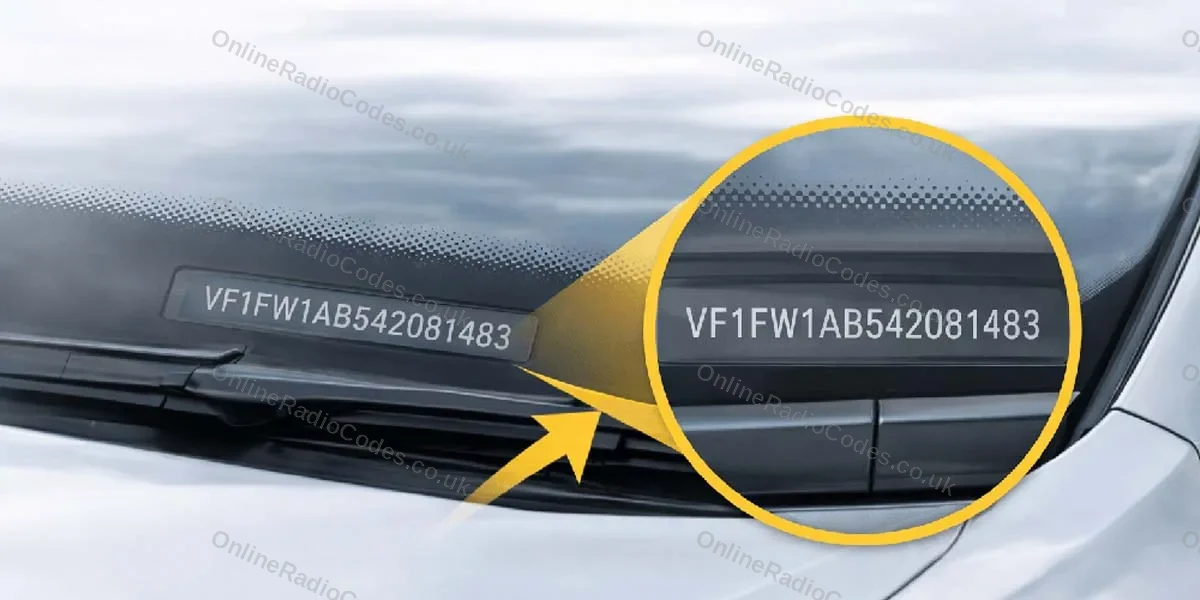
The VIN belongs to the car, the serial belongs to the radio
We are asked this several times a week, often by someone who has just spent ten minutes looking for a sticker that turns out to be the wrong one. The two numbers do different jobs.
The VIN (vehicle identification number, also called the chassis number) identifies the car. It is 17 characters long and printed on the registration document, at the bottom of the windscreen and on the driver's door pillar.
The serial number identifies the radio. It is on a label on the radio's case, and some radios will show it on the screen. It has nothing to do with the car the radio sits in. Move the radio to another car and the serial goes with it, and so does the code.
The code is set inside the radio when it is made, which is why we usually need the radio's serial. Renault and Dacia are different, and so are the newer Suzuki SLN touchscreens. Their codes can be looked up from the VIN, so for those the VIN does the job and the radio can stay where it is.
Your number plate is neither of these. A registration number cannot find a radio code on its own, but the registration document that goes with it carries the VIN.
Which number your make needs
Find your make below. If it is not listed, it needs the serial from the radio, and its own page shows where to look.
| Make | What we need | Where to find it |
|---|---|---|
| Renault | The VIN, if the radio is the one the car was built with. Older radios use a precode instead: one letter and three digits. | VIN: registration document, windscreen, driver's door pillar. Precode: the radio label, often the last four characters of a longer barcode. |
| Dacia | The same as Renault. Dacia VINs start UU1 or VF. | The same places as Renault. |
| Suzuki | SLN touchscreen: the VIN only. Bosch touchscreen: the serial, device number and date. Older Bosch and Blaupunkt CD radios: the long number under the barcode. | SLN: the same places as Renault. Bosch touchscreen: on screen after three wrong PIN entries. CD radios: the casing label, so the radio has to come out. |
| VW, Audi, SEAT, Skoda | The radio serial: 14 characters starting VWZ, AUZ, SEZ or SKZ. Not the VIN. | The label on the radio case. The radio has to slide out to read it. |
| Ford | The radio serial: a letter and six digits, such as M123456 or V123456. | Many Ford radios can bring it up on screen. Otherwise the case label. |
| Nissan | The radio serial. | Connect and Daewoo units show it on screen after three wrong entries. Clarion (CL, PN, PP) and Blaupunkt (BP) units have it on the case label. |
| Everything else | The radio serial. | Usually the case label. Each brand page shows where, with photos. |
The VIN only works for the original radio
For Renault, Dacia and Suzuki SLN, the VIN finds the code of the radio the car was built with. That is the catch. If the radio has been changed since, for a second hand unit or after a repair, the VIN still points at the old radio, and the one in your dashboard will refuse its code.
If you have had the car from new and nobody has touched the radio, use the VIN. If you bought the car used and cannot be sure, the VIN is still a sensible place to start, because it means no tools and nothing to take apart.
On older Renault and Dacia radios there is a better option. The precode on the label belongs to the radio itself, so it works whatever car the radio is in. If you can see one letter and three digits on the label, that is the number to use.
Where the VIN is, and how to read it
- Registration document. On the UK V5C and on most European registration certificates it is in the box marked E. Elsewhere it is usually labelled VIN or chassis number.
- Bottom of the windscreen. A small plate you can read through the glass from outside.
- Driver's door pillar. A sticker you can see with the door open.
Chassis number, frame number and VIN all mean the same 17 characters. If your paperwork uses one of those names, you have the right number.
Read it slowly. A VIN never uses the letters I, O or Q, so a round character is always the number 0 and a single upright stroke is the number 1. Then count: it is always 17.
The first three characters tell you who built the car. Renault VINs from Europe start VF1, and Latin American ones usually start 9FB, 93Y or 8A1. European Dacia VINs start UU1 or VF. A Duster, Logan or Sandero sold as a Renault in Mexico, Brazil or Argentina carries a Renault VIN, so it goes on the Renault page.
When the box will not take your number
You typed a VIN on a page that needs a serial. The box will tell you it is the vehicle VIN and ask for the radio's serial. There is nothing wrong with your VIN. That make works from the radio, so check the table above for where its serial is.
You typed a VIN on the Renault or Dacia page and it was refused. Count the characters and check the first three against the list above. The box sorts out spaces and the I, O and Q mix ups by itself, so a refusal there usually means a character has been missed or typed twice.
You typed the number from the radio label and it was refused. Labels carry a part number as well as the serial, and the two look alike. On a Suzuki CD radio, for example, the Suzuki part number starting 39101 is not the one we need. Each brand page shows which line of the label to read.
The VIN went through but the code did not arrive straight away. Some VINs are not in the records we check first. The team then looks it up by hand and emails the code, usually within the hour.
The code came from the VIN but the radio will not take it. The radio has probably been replaced at some point. Reply to your code email with a photo of the radio screen and the label on the radio, and our team will help from there.


Questions we get asked
For Renault, Dacia and the newer Suzuki SLN touchscreens, yes, as long as the radio is the one the car was built with. For every other make we work from the serial number on the radio itself.
No. The VIN is the car's 17 character number. The serial belongs to the radio and is on the label on its case, or on the screen for some radios. The table in this guide shows where it is for your make.
On your registration document (box E on the UK V5C and on most European registration certificates), on a small plate at the bottom of the windscreen, and on a sticker on the driver's door pillar.
They are the same thing. Chassis number, frame number and VIN are three names for the car's 17 character number. Renault, Dacia and Suzuki SLN work from it. Every other make needs the radio's serial instead.
For Renault, Dacia and Suzuki SLN, yes, and a radio that has been in the car since new is exactly when the VIN works best. For other makes we still need the radio's serial, even on the original radio.
Not from the number plate itself. The registration document that goes with it carries the VIN, which is enough for Renault, Dacia and Suzuki SLN. For other makes the code comes from the serial on the radio.
Ready to unlock your radio?
Choose your make, type the serial number and we take it from there.